Regarding weight loss, many people are concerned about how much weight they have lost every day, in fact, the most important thing to pay attention to is the body fat percentage, because the body fat percentage is the gold standard for measuring whether or not to be obese.
In this article, we will systematically talk about body fat percentage, so that everyone knows how much body fat percentage is healthy, how much body fat percentage to get out of the vest line, how to measure body fat percentage, and how to lose less muscle and lose more body fat.
1. What is body fat percentage?
Body fat is the fat in the body, including both our subcutaneous fat and visceral fat, body fat and non-fat components in muscles, water, bones, and organs, and the added weight is body weight.
The ratio of fat to body weight is the body fat percentage, and the formula is: body fat percentage = fat ÷ body weight.
2. How important is it to pay attention to body fat percentage for weight loss?
The following picture should be familiar to everyone.
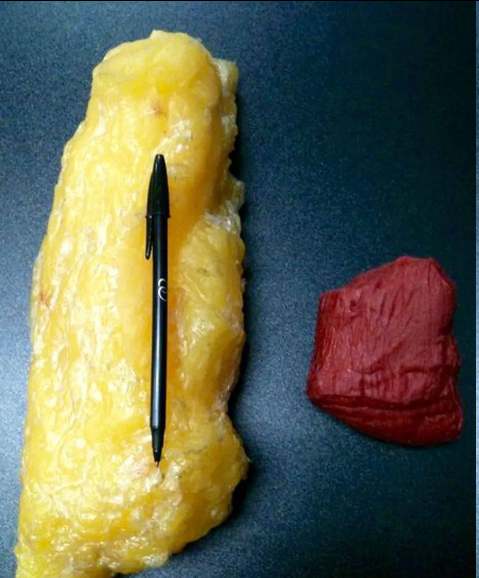
The weight of fat and muscle in the picture is the same, but the volume of fat looks at least 3 times that of muscle.
We talk about how many pounds of weight we have lost, in fact, we have both fat and muscle, if we can lose more fat and lose less muscle, then we will look slimmer.
In addition, muscle tissue is very "lively" and adipose tissue is very "lazy", that is, even when inactive, muscles consume more energy than fat.
So if you lose a lot of muscle, it means that the human body consumes less energy when you are inactive, which is bad news for weight loss.
3. What is the range of healthy body fat percentage?
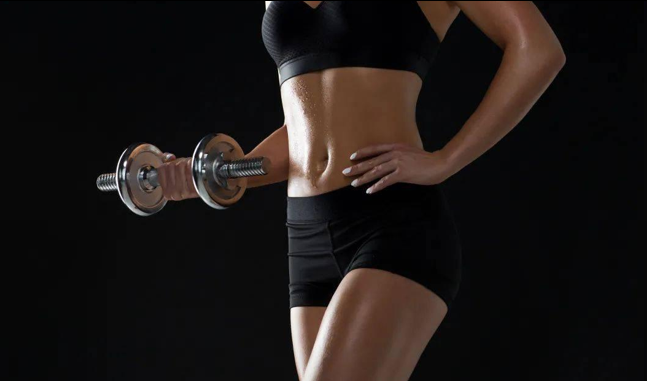
According to Grodner et al., the healthy body fat range is 15%~20% for men and 25%~30% for women.
The picture below also gives the ideal body fat range for different age groups, which we can also refer to.
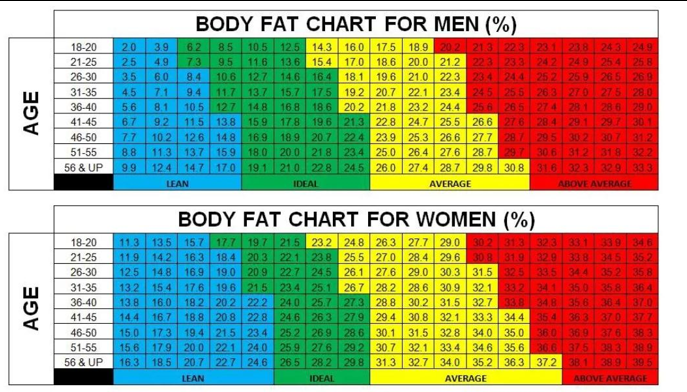
The top is male, the bottom is female, the leftmost column is the age range, and the green part is the ideal body fat range.
For example, for women aged 26-30, the ideal body fat range is 20.9%~24.5%.
4. What is the body fat percentage greater than obesity?
Refer to the Japanese standard, as follows.
Adult men: Body fat percentage higher than 20% is mild obesity
Adult women: body fat percentage higher than 30% is mild obesity
If you are fat, the risk of chronic diseases such as type 2 diabetes, dyslipidemia, hypertension, and stroke will increase. In addition, being fat will also affect fertility, not only affecting female ovulation function, but also affecting male sperm quality.
5. How much body fat percentage can there be vest line/mermaid line?
Men's line abs are called mermaid lines, and women's lines are called vest lines.
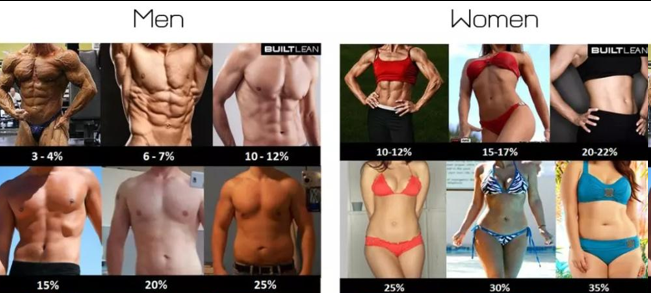
It can be seen from the picture:
The male body fat percentage must be less than 15% before the mermaid line will be used, and the mermaid line between 10%~12% is super perfect.
A woman's body fat percentage is about 17% can produce a vest line, in fact, I think 20%~22% of the physique is also quite beautiful, what do you think?
6. How low is the body fat percentage harmful to health?
The required body fat percentage for men should be at least 3%~8%, and the above live-action picture allows everyone to feel it.
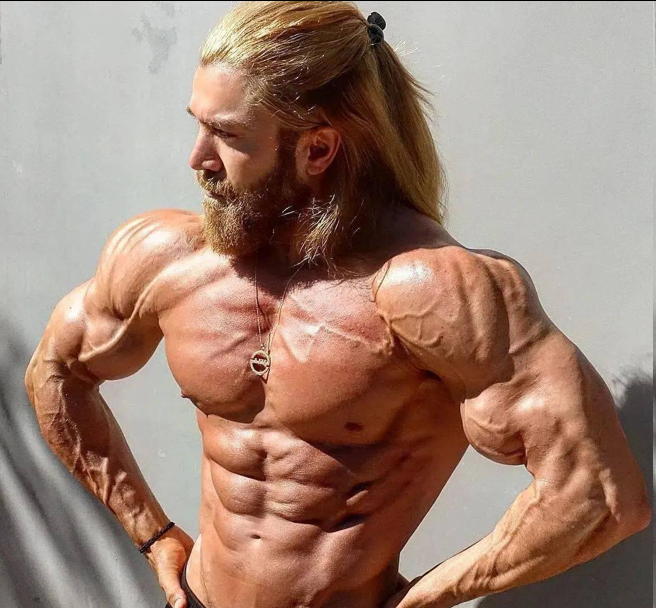

This is Sean Raysay, who has a perennial body fat percentage of 3%~5%, and is said to be a god in the fitness circle.
The required body fat percentage of women should be at least 12%~14%, and if it is lower, problems such as delayed menstruation, amenorrhea, infertility, and early menopause may occur.
Why is this happening?
This is because: lipids are necessary raw materials for the synthesis of estrogen and progesterone, and adipose tissue can also store these hormones, and if the body fat percentage is too low, it will affect the secretion of these hormones, resulting in the various problems mentioned above.
We will find that some girls have delayed menstruation and amenorrhea if their body fat has not been reduced so low.
Therefore, in the process of losing weight, you must follow your own situation, and do not blindly pursue a certain body fat percentage data.
7. How to measure body fat percentage?
Methods for measuring body fat percentage are:
Dual-energy X-ray absorptiometry technology
Computerized tomography
nuclear magnetic resonance
Bioelectrical resistance analysis
8. Which method measures body fat accurately?
The first three methods measure body fat percentage more accurately, with DEXA being the gold standard.
The second and third methods can also measure the fat distribution of the body, but because the equipment is expensive, they are basically used in clinical and research.
The body fat meter used in the gym and the body fat scale used at home are both measured by the BIA method. BIA This method measures body fat percentage less accurately.
9. Is it meaningless if the body fat measured by BIA is inaccurate?
It is meaningful and feasible to compare body fat before and after in the weight loss process.
However, it is important to note the following:
1. Try to measure the same body fat scale, at the same time and in the same place.
2. Do not measure immediately after exercise, it is best to rest for half an hour before taking the test.
3. If you need to take medication at ordinary times, do not stop taking it because of measurement.
4. Do not drink strong coffee, strong tea, and do not smoke 4 hours before the measurement.
You can usually look in the mirror, pinch your stomach, and measure your waist circumference, so that it will be more intuitive to judge your body fat percentage.
10. If the body fat percentage is not measured, how to judge whether to lose weight?
According to the "Expert Consensus on the Prevention and Control of Obesity for Chinese Residents", as long as one of them exceeds the standard, you have to lose weight. Of course, there are special circumstances, if you exercise regularly and do not measure body fat, the body fat percentage is not high at a glance, and you do not need to lose weight even if the BMI exceeds the standard. In addition, for the elderly over 65 years old, the appropriate BMI is 20-26.9, and it cannot be measured according to the BMI standard of ordinary people.
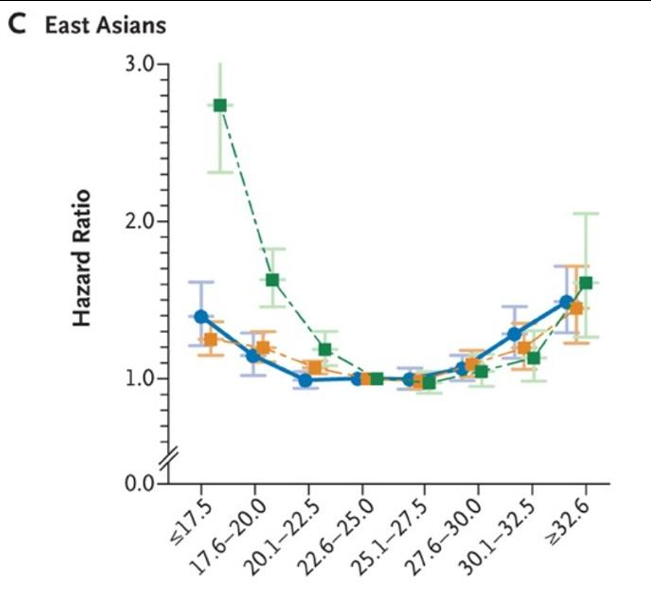
BMI and waist circumference are normal, but if you feel a little fat, don't lose it, published in the New England Journal of Medicine, a study of more than 1 million Asians showed that BMI has the lowest mortality rate between 22.6 and 27.4. [1] So don't pursue a lower BMI or weight, just eat well and exercise moderately, if you grow muscle, reduce fat, and have a firmer body shape. BMI and waist circumference are normal, and it doesn't matter if the body shape does not change, at least we have improved our lung capacity, which is of great significance to health.
11. How to eat less muscle loss and fat loss?
While losing fat, it is necessary to ensure muscle mass and reduce muscle loss as much as possible, so as to achieve the best shaping effect. To avoid muscle loss during weight loss, in addition to moderate exercise, you should also pay attention to supplementing foods rich in high-quality protein in your diet.
Meat, eggs and milk are high-quality protein-rich foods, it is recommended to eat 1 egg a day (don't lose the yolk), 1~2 packs of milk (whole milk is fine), livestock and poultry meat add up to at least 40 grams, more can eat 100 grams, fish and shrimp meat at least 40 grams, more can eat 100 grams, soy products eat 50 grams of dried tofu or 100 grams of northern tofu every day.
In addition to choosing protein foods, in order to give priority to protein for muscle tissue repair, you must eat enough carbohydrates, and only when carbohydrates are sufficient can you save protein.
It is recommended to choose staple foods with thick and thin carbohydrates, such as oat rice, multigrain multi-bean rice, buckwheat rice, multigrain steamed buns, whole wheat bread, etc., and it is recommended that women and men eat at least 50 or 75 grams of raw rice per meal. 50 grams of uncooked rice or the corresponding staple food is: 2 slices of whole wheat bread or 130 grams of rice/noodles (about 1 fist).
As for vegetables, it is recommended to eat 300-500 grams throughout the day, about 5 fists after cooking.
In addition, it should be noted that cooking oil should be controlled at 25~30 grams/day, and give preference to oils rich in unsaturated fatty acids, such as sunflower oil, soybean oil, peanut oil for stir-frying, flaxseed oil, walnut oil, sesame oil, etc. for cold salads.